
Collateral charge mortgage: why switching can cost more than you expect
The way your mortgage is registered on title rarely comes up when you sign, but it can matter at renewal or when you refinance. Here's how a collateral charge differs from a standard charge, what it can cost to switch lenders, and how to find out which one you have.
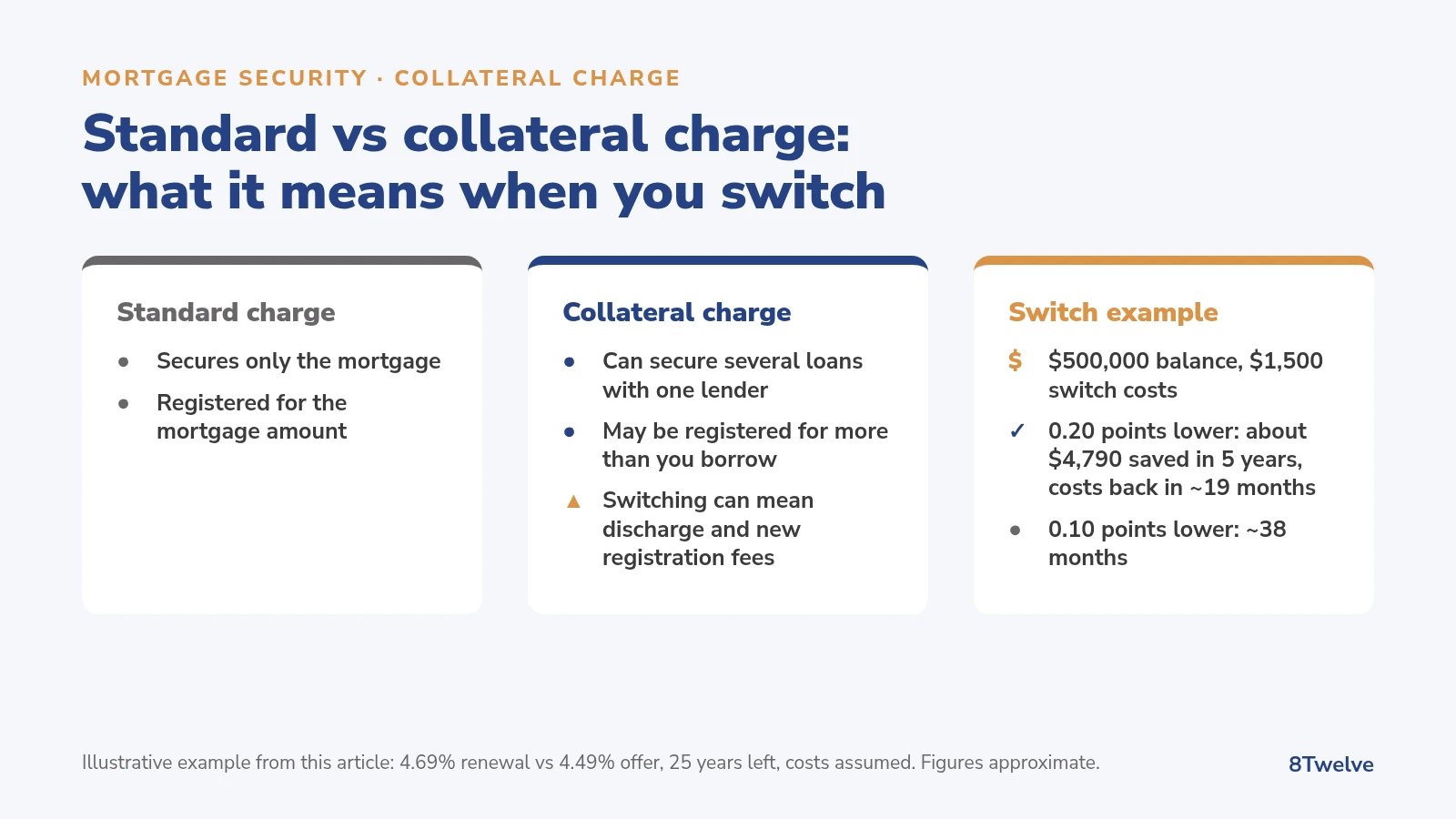
A collateral charge mortgage is registered on your property in a way that can secure more than one loan with the same lender, such as a mortgage and a line of credit, and the lender may register it for more than you borrow. FCAC says this lets you borrow more later without paying to discharge and re-register, but switching lenders can mean paying fees to remove the charge and register a new one, and every loan secured by the charge must be repaid or moved. A standard charge secures only the mortgage, for the mortgage amount. In our example, switching a $500,000 balance to a rate 0.20 points lower saves about $4,790 in interest over five years, so $1,500 in switching costs is recovered in about 19 months. At 0.10 points, it takes about 38 months.
Key takeaways
- →A collateral charge can secure several loans with one lender, such as a mortgage and a line of credit, and may be registered for more than you borrow, per FCAC.
- →The upside: you may borrow more later without paying to discharge and re-register your mortgage.
- →The trade-off: switching lenders can mean legal and registration costs, and every loan under the charge must be repaid or moved.
- →A standard charge secures only the mortgage, for the mortgage amount.
- →Find out which one you have a few months before renewal by asking your lender or lawyer, so the cost is part of your decision.
Short answer: A collateral charge mortgage is a mortgage registered on your property in a way that can secure more than one loan with the same lender, such as your mortgage and a line of credit. FCAC notes the lender may register the charge for more than the amount of your mortgage, so you can borrow more later without paying to discharge your mortgage and register a new one [1]. The trade-off shows up when you want to switch lenders: FCAC says you may have to pay fees to remove the collateral charge and register a new one, and all loans secured by it must be repaid or transferred [2].
This guide compares collateral and standard charges, works through the cost of switching and shows how to find out which one you have. If you're thinking about a refinance, our mortgage refinancing page explains how we compare lenders.
Collateral vs standard charge at a glance
When you take out a mortgage, the lender registers a charge on your property, and the type of charge decides which loans that lender can secure against it [1].
| Standard charge | Collateral charge | |
|---|---|---|
| What it secures | Only the mortgage [1] | Can secure several loans with the same lender, such as a mortgage and a line of credit [1] |
| Registered amount | The mortgage amount [1] | May be higher than the mortgage amount [1] |
| Borrowing more later | Usually a refinance, with new legal work | May be possible without a new registration, OAC [1] |
| Switching lenders at renewal | In our experience, often simpler and sometimes done by transfer | May need a discharge and new registration; all secured loans repaid or moved [2] |
| Common with | Many stand-alone mortgages | In our experience, many mortgage-plus-HELOC products |
Rows marked "our experience" reflect what we see across lenders; registration practices vary by lender and province.
Why it matters when you switch
FCAC says that if your mortgage is registered with a collateral charge and you want to switch lenders, you may have to pay fees to remove the charge from your existing mortgage and register the new one [2]. You must also repay in full, or move to the new lender, every loan agreement secured by the collateral charge, including car loans or lines of credit [2].
The costs can include:
- A discharge fee from your current lender. FCAC says that where it isn't regulated, it typically ranges from no charge up to $400 [3].
- Legal or notary fees to discharge and register. FCAC puts professional fees for a discharge at typically $400 to $2,500 [3].
- Appraisal and other setup fees with the new lender [2].
In our experience, some lenders will cover part or all of the legal costs to win a switch, so ask. Our guide to mortgage transfer fees breaks down who usually pays what.
Not sure how your mortgage is registered? A licensed 8Twelve agent can check your charge type, the cost to switch and whether a new lender will cover it, across 65+ lenders, OAC. Review your refinance options
Is switching still worth it? A worked example
You owe $500,000 with 25 years of amortization left, and your renewal offer is 4.69%. Another lender offers 4.49%. Switching costs, including discharge and legal work on a collateral charge, are assumed at $1,500 in total.
| Rate difference | Interest saved over 5 years | Saved per month (average) | Months to recover $1,500 | Net after 5 years |
|---|---|---|---|---|
| 0.20 points (4.69% vs 4.49%) | about $4,790 | about $80 | about 19 | about $3,290 |
| 0.10 points (4.69% vs 4.59%) | about $2,400 | about $40 | about 38 | about $900 |
Rates and costs are assumptions for illustration, not offers. Calculated in Python with semi-annual compounding.
What it shows: a collateral charge rarely makes switching a bad idea on its own, but it narrows the margin. On a small rate gap, costs you didn't expect can wipe out much of the saving. If the new lender pays the legal costs, the saving goes back to you. For uninsured mortgages, OSFI doesn't expect federally regulated lenders to apply the stress test to a straight switch at renewal with no increase to the loan or amortization [4]; our guide to the mortgage switch stress test explains the details.
The upside of a collateral charge
A collateral charge isn't bad. It can suit you if:
- You expect to borrow again, for example for a renovation, and want to avoid new legal fees each time [1].
- You want a mortgage and a line of credit together under one registration. Our HELOC vs refinance guide compares those choices.
- You plan to stay with the same lender for the long term, so switching costs matter less.
The caution from FCAC on home equity applies here: easy access to credit can tempt you to borrow more than you need, and any borrowing secured by your home puts the home at risk if you can't repay [5].
How to find out which charge you have
- Ask your lender whether your mortgage is registered as a standard or collateral charge, and for what amount [2].
- Ask the lawyer or notary who closed your mortgage; it's in your reporting letter.
- Do it early. FCAC suggests allowing a few months before your renewal date, so you have time to weigh your options [2].
- List every loan with that lender that might be secured by the charge: lines of credit and car loans, for example [2].
Questions to ask before you sign a new mortgage
- Is this a standard or collateral charge, and for what registered amount?
- Which of my other loans with you would it secure?
- What will it cost to discharge if I switch at renewal?
- Will a new lender's legal costs be covered if I move?
From our desk: borrowers rarely regret a collateral charge they chose for a reason. The surprises come when nobody explained it at signing. Ask the question once, write down the answer and keep it with your mortgage papers.
A collateral charge mortgage trades easier borrowing later for a costlier switch. Find out which charge you have before renewal, price the switching costs into the comparison and ask whether the new lender will cover them.
Run the numbers: compare renewal offers with our mortgage renewal calculator, or read our complete mortgage refinance guide.
This article is for general information only and isn't financial, legal or tax advice. Rates, products and terms change without notice and are available on approved credit (OAC). The rate and terms you qualify for depend on your individual financial situation, including credit, income, property and loan-to-value. "Best rates" means the most suitable options available for your situation, not a guarantee of the lowest rate. Example rates and payments are for illustration only, as of October 2026, and are not an offer. 8Twelve Mortgage arranges mortgages through 65+ lenders and does not lend directly. Licensed across Canada — see our licences.
Examples are for illustration only, as of October 31, 2026, and are not offers. Registration practices, discharge and legal fees, and lender cost coverage vary by lender and province; approval is OAC. Rules checked against FCAC and OSFI on October 31, 2026. 8Twelve does not lend or fund mortgages; we arrange them with third-party lenders.
Frequently asked questions
Sources
- Choosing a mortgage that is right for you (standard and collateral charges) - FCAC
- Renewing your mortgage (switching lenders if you have a collateral charge) - FCAC
- Discharging a mortgage (discharge and professional fees) - FCAC
- Minimum qualifying rate for uninsured mortgages - OSFI
- Home equity lines of credit - FCAC
Last reviewed on November 3, 2026