
Readvanceable mortgage in Canada: how your credit line grows as you pay down
A readvanceable mortgage combines a mortgage with a home equity line of credit under one limit, so every principal payment can free up room to borrow again. Here's how the readvance works, a five-year worked example, who it suits and the risks to plan around.
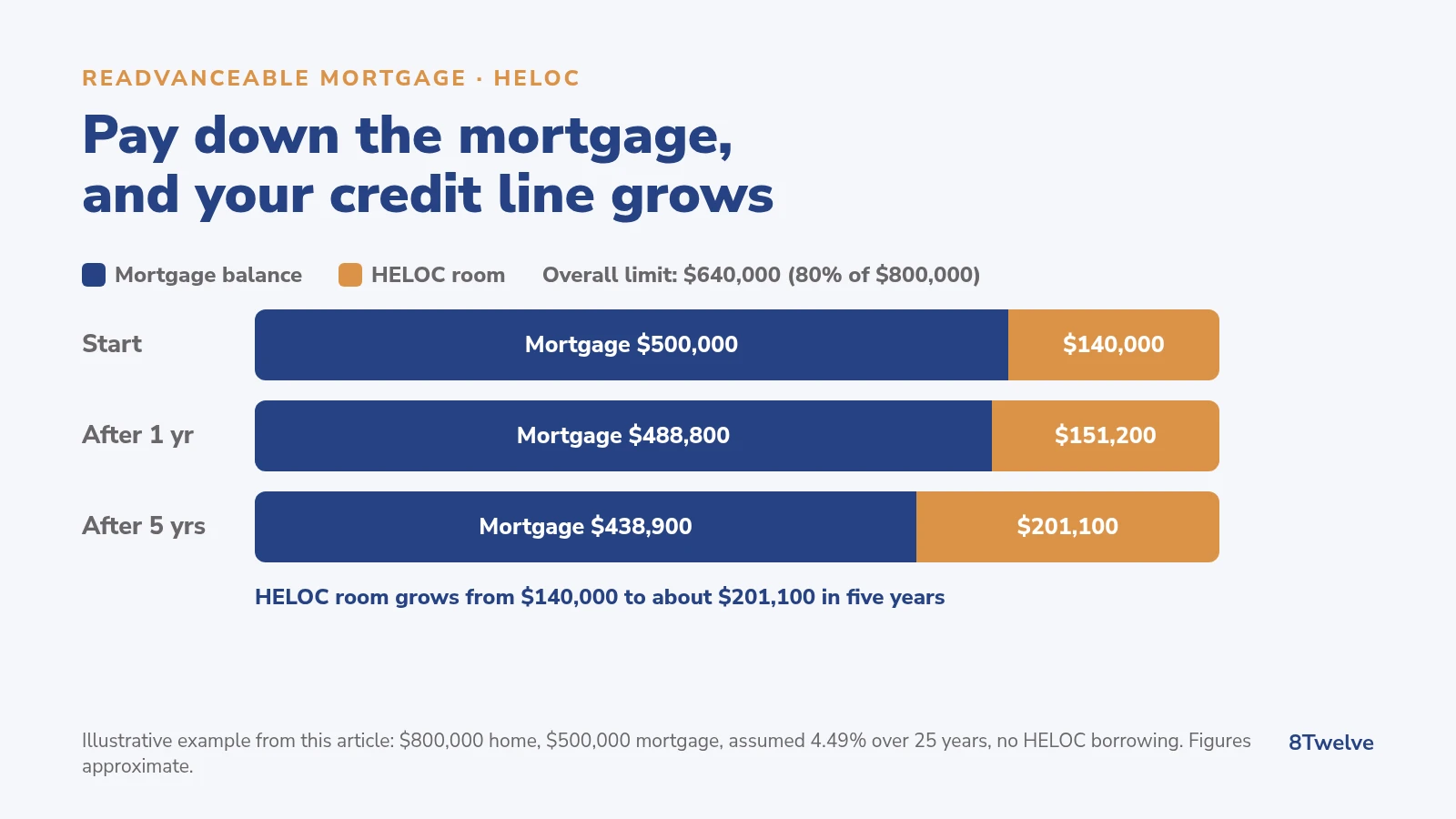
A readvanceable mortgage in Canada is a mortgage combined with a home equity line of credit (HELOC) from the same lender, under one overall limit. FCAC says the available credit increases as you pay down your mortgage principal, and you need at least 20% equity. Total borrowing is usually capped at 80% of your home's value, and under OSFI's guideline the revolving HELOC part is capped at 65%. In our example, an $800,000 home with a $500,000 mortgage starts with $140,000 of HELOC room; after five years of regular payments at an assumed 4.49%, about $61,100 of principal is repaid and the room grows to about $201,100. That flexibility is useful, but it also makes it easy to stay in debt, and switching lenders can be harder.
Key takeaways
- →A readvanceable mortgage combines a mortgage and a HELOC with the same lender under one overall limit; FCAC calls it a HELOC combined with a mortgage.
- →Your HELOC room grows as you pay down principal, so each mortgage payment can free up credit to borrow again.
- →Limits: total borrowing is usually capped at 80% of your home's value, and the revolving HELOC part at 65%.
- →You need at least 20% equity for this type of HELOC, per FCAC, and you must qualify, including the stress test at a bank.
- →The risks are behavioural and practical: easy re-borrowing, variable HELOC rates and a harder switch at renewal.
Short answer: A readvanceable mortgage in Canada is a mortgage and a home equity line of credit (HELOC) combined under one overall limit with the same lender. FCAC describes it as a HELOC combined with a mortgage, "also sometimes called a readvanceable mortgage," and explains that your available credit increases as you pay down your mortgage principal [1]. Many financial institutions sell this kind of product under their own brand name [1].
This guide explains how the readvance works, walks through a five-year example and covers who it suits and the risks. To compare options, see our home equity line of credit page.
How a readvanceable mortgage works
Think of it as one umbrella limit with two or more parts underneath:
- The overall limit. You can usually borrow up to 80% of your home's value in total, secured by your home [2].
- The mortgage part. Regular payments of principal and interest. In our experience, many products let you split this into more than one portion, for example part fixed and part variable, each with its own term.
- The HELOC part. Revolving credit you can draw, repay and draw again, with interest charged only on what you use [1]. Under OSFI's guideline for federally regulated lenders, the revolving, non-amortizing part is capped at 65% of the home's value, and anything above that should be amortizing [3].
- The readvance. Each principal payment lowers the mortgage balance, and the HELOC room rises by the same amount, up to the overall limit [1].
You need at least 20% equity for a HELOC combined with a mortgage, and you must pass the stress test to get a HELOC at a bank [1].
A five-year worked example
Illustration: your home is worth $800,000 and you have a $500,000 mortgage at an assumed 4.49% over 25 years. The overall limit is 80% of value, or $640,000.
| At the start | After 1 year | After 5 years | |
|---|---|---|---|
| Mortgage balance | $500,000 | about $488,800 | about $438,900 |
| Principal repaid | — | about $11,200 | about $61,100 |
| HELOC room (up to $640,000 total) | $140,000 | about $151,200 | about $201,100 |
Assumes the home's value doesn't change, regular monthly payments of about $2,765 and no HELOC borrowing. Calculated in Python with semi-annual compounding; the rate is an assumption, not an offer.
What it shows: the room grows automatically, so the HELOC is there when you need it, without a new application. But if you draw the room as fast as it appears, your total debt stays near $640,000 and you never really pay your home off. On $140,000 drawn at an assumed 5.95% HELOC rate, interest-only payments would be about $694 a month, and each 0.25-point rise adds about $350 a year.
Wondering if a readvanceable mortgage fits? A licensed 8Twelve agent can compare combined mortgage-and-HELOC products with a standard mortgage across 65+ lenders, OAC. Explore HELOC options
Readvanceable mortgage vs standalone HELOC
| Readvanceable (combined) | Standalone HELOC | |
|---|---|---|
| Lender | Same lender as your mortgage [1] | Can be a different lender [1] |
| Minimum equity | 20% [1] | More than 35% [1] |
| Does the limit grow as you pay the mortgage? | Yes, up to the overall limit [1] | No [1] |
| Switching your mortgage later | All parts usually move or are repaid together [4] | The mortgage and the HELOC can move separately |
Last row: FCAC says all loans under a collateral charge must be repaid or transferred to switch [4]; in our experience, many combined products are registered that way.
Who it can suit
- Homeowners planning ongoing projects, like staged renovations, who want access without reapplying.
- Disciplined borrowers who want an emergency backstop and will repay draws on a schedule.
- People who want flexibility within one lender, such as splitting the mortgage into fixed and variable parts.
If you're using borrowed money to invest, the tax rules on interest are specific; speak with a tax professional before you rely on any deduction.
The risks to plan around
- Easy re-borrowing. FCAC warns that easy access to funds may tempt you to take on more debt than you can repay, and that paying only interest won't pay off the loan [1]. Set a purpose and a repayment schedule for every draw.
- Variable rates. HELOCs usually have variable rates tied to the lender's prime rate, which may change when the Bank of Canada changes its policy rate [1]. The Bank raised its policy rate to 2.5% on October 28, 2026, with the next decision on December 9 [5]. Our HELOC rates guide explains how lines are priced.
- Limits can be reviewed. OSFI expects lenders to review HELOC limits if your home's value drops materially or your finances change [3].
- A harder switch. To move to another lender, you'll usually need to repay or move every part, and pay to discharge and re-register [4].
Other ways to borrow against your home
- Need one lump sum? A refinance or home equity loan may fit better; see HELOC vs refinance and our home equity loan guide.
- Comparing every option? Our home equity takeout guide lays them side by side.
From our desk: the readvanceable mortgages that work well have a rule attached, such as "every draw gets its own payoff date." Without one, the growing room quietly becomes a permanent balance.
A readvanceable mortgage turns your principal payments into available credit, which can be a useful tool for planned, repayable borrowing. Know the 80% and 65% limits, plan for variable rates and price in a harder switch before you sign.
Run the numbers: estimate payments with our mortgage payment calculator, or compare HELOC rates.
This article is for general information only and isn't financial, legal or tax advice. Rates, products and terms change without notice and are available on approved credit (OAC). The rate and terms you qualify for depend on your individual financial situation, including credit, income, property and loan-to-value. "Best rates" means the most suitable options available for your situation, not a guarantee of the lowest rate. Example rates and payments are for illustration only, as of October 2026, and are not an offer. 8Twelve Mortgage arranges mortgages through 65+ lenders and does not lend directly. Licensed across Canada — see our licences.
Examples are for illustration only, as of October 31, 2026, and are not offers. Readvanceable mortgage and HELOC limits, rates and terms vary by lender and are available OAC. Rules checked against FCAC, OSFI and the Bank of Canada on October 31, 2026. 8Twelve does not lend or fund mortgages or HELOCs; we arrange them with third-party lenders.
Frequently asked questions
Sources
- Home equity lines of credit (HELOC combined with a mortgage) - FCAC
- Borrowing against home equity - FCAC
- Guideline B-20: Residential Mortgage Underwriting Practices and Procedures - OSFI
- Renewing your mortgage (switching lenders if you have a collateral charge) - FCAC
- Bank of Canada increases policy rate to 2.5% (October 28, 2026) - Bank of Canada
Last reviewed on November 3, 2026