
How much does a reverse mortgage cost? Fees, interest and what's left after 20 years
A reverse mortgage costs more than its upfront fees. Here's what you pay to set one up, how fast the balance grows at two illustrative rates over 5 to 20 years, and how much equity may be left at the end.
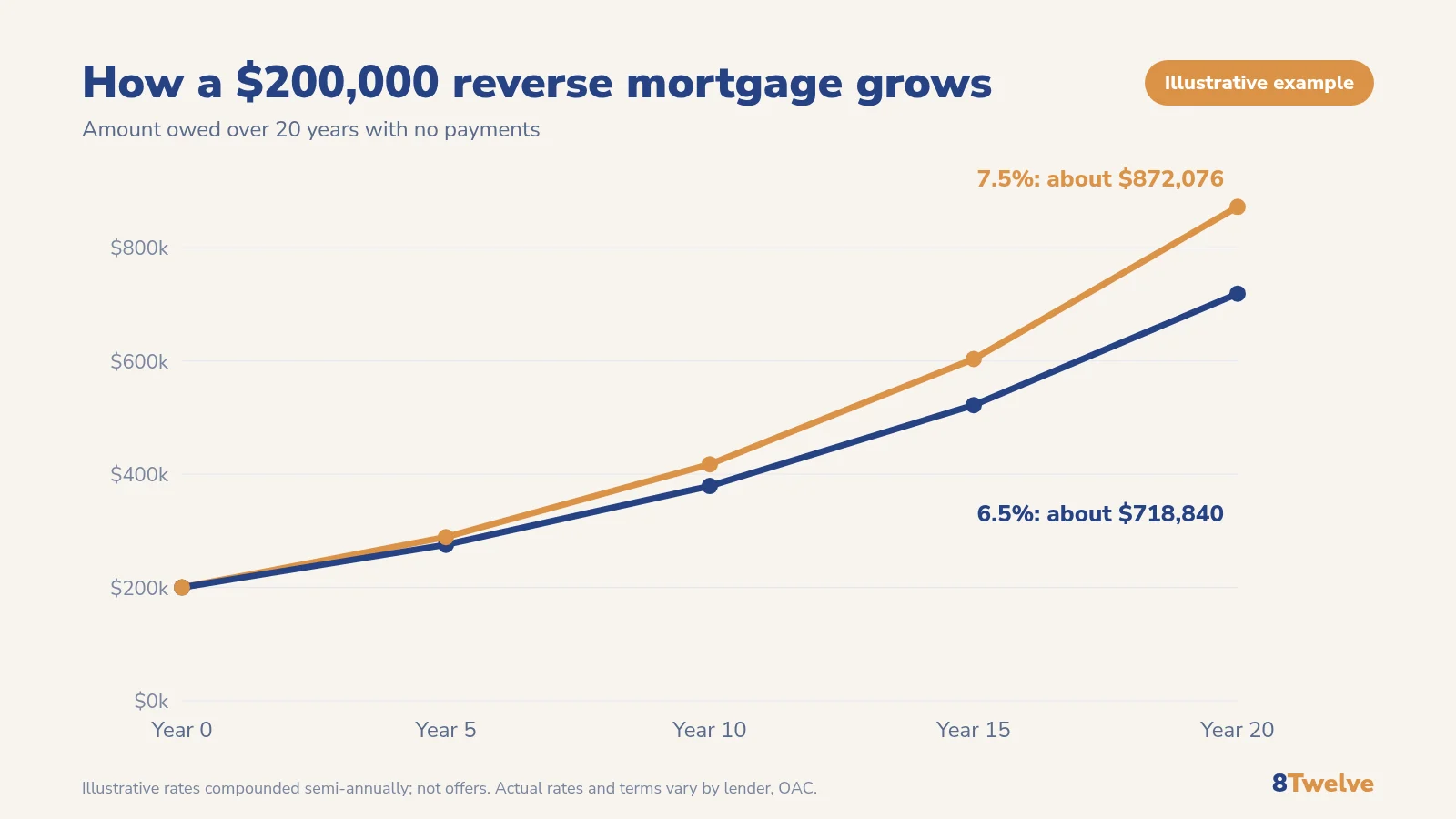
How much a reverse mortgage costs depends on three things: upfront fees, the interest that compounds on the balance while you live in the home, and any prepayment penalty if you repay early. FCAC lists appraisal, set-up, legal and closing costs, and says reverse mortgage rates are usually higher than regular mortgage or HELOC rates. In our example, $200,000 grows to about $379,168 after 10 years at an illustrative 6.5% and about $417,630 at 7.5%; after 20 years, about $718,840 and $872,076. On an $800,000 home that grows 2% a year, that leaves about $469,918 or $316,682 in equity after 20 years. Upfront costs in the example total about $3,600 (assumed). OAC.
Key takeaways
- →How much a reverse mortgage costs depends mostly on interest, not fees: interest is added to the balance and compounds for as long as you have the loan.
- →Upfront costs include appraisal, set-up, legal and closing costs, according to FCAC; about $3,600 in our assumed example.
- →The balance can roughly double in about 10 years at the illustrative rates in our example.
- →Prepayment penalties can apply if you sell or repay within the first few years.
- →Take only what you need. Borrowing less, or in stages, keeps the compounding smaller.
Short answer: How much a reverse mortgage costs depends on three things: upfront fees, the interest that builds on your balance while you live in the home, and any prepayment penalty if you repay early [1]. Over time, interest is by far the biggest cost. Because you don't make regular payments, interest is added to the balance and you pay interest on that interest, so the amount owed grows faster each year [1].
This guide is for homeowners 55 and older, and their families, who want to see the full cost before deciding. We show the upfront costs, how a $200,000 balance grows over 5 to 20 years at two illustrative rates and how much equity may be left. For eligibility and how it works, see our reverse mortgage options.
The three parts of reverse mortgage cost
| Cost | When you pay it | Example (assumed) |
|---|---|---|
| Set-up or administrative fee | At closing [1] | $1,800 |
| Independent legal advice | At closing [1] | $800 |
| Home appraisal | Before approval [1] | $600 |
| Title, registration and other closing costs | At closing [1] | $400 |
| Upfront total | about $3,600 | |
| Interest | Added to the balance every period, paid when the loan is repaid [1] | See the growth table below |
| Prepayment penalty | Only if you repay early, for example by selling in the first few years [1] | Varies by lender and term |
Fee types from FCAC; dollar amounts are assumptions for illustration, as of November 4, 2026. Some lenders deduct fees from the loan amount; ask for a written breakdown.
FCAC also notes that reverse mortgage rates are usually higher than rates on a regular mortgage or a HELOC [1]. Our guide to reverse mortgage requirements in Canada explains how the amount you can borrow is set.
Want to see the real cost for your home? A licensed 8Twelve agent can compare reverse mortgage fees, rates and penalties across 65+ lenders, OAC. Prefer the phone? Many 55+ clients do. Explore reverse mortgage options
How fast the balance grows: 5 to 20 years
Example: you're 70 and take a $200,000 lump sum on an $800,000 mortgage-free home, with no payments.
| Years | Owed at 6.5% | Owed at 7.5% |
|---|---|---|
| 0 | $200,000 | $200,000 |
| 5 | about $275,379 | about $289,009 |
| 10 | about $379,168 | about $417,630 |
| 15 | about $522,074 | about $603,494 |
| 20 | about $718,840 | about $872,076 |
Rates are illustrative assumptions, compounded semi-annually, and are not offers; actual rates, terms and compounding vary by lender, OAC.
What it shows: at these rates the balance roughly doubles in 10 to 11 years. The cost of the loan over 20 years, beyond the $200,000 borrowed, is about $518,840 at 6.5% and about $672,076 at 7.5%. One percentage point makes a gap of more than $150,000 by year 20.
What equity is left?
| Home value growth | Equity after 10 years (6.5% / 7.5%) | Equity after 20 years (6.5% / 7.5%) |
|---|---|---|
| 0% a year (home stays at $800,000) | about $420,832 / $382,370 | about $81,160 / below zero |
| 2% a year (home reaches about $1,188,758 by year 20) | about $596,028 / $557,565 | about $469,918 / $316,682 |
Home value growth rates are assumptions for illustration only; home values can fall as well as rise.
If the balance ever grows larger than the home's value, what happens depends on your contract. Ask the lender, in writing, whether the amount you or your estate owe is limited to the home's fair market value when it's sold, and what conditions apply.
Lump sum or staged: how the cost changes
How you take the money matters as much as the rate. Example: instead of $200,000 up front, you take $100,000 now and $100,000 five years later, at the same illustrative 6.5%.
| After 20 years | Owed |
|---|---|
| $200,000 lump sum on day one | about $718,840 |
| $100,000 now + $100,000 in year 5 | about $620,457 |
| Difference | about $98,383 |
Illustrative 6.5% rate compounded semi-annually; not an offer. Lender rules on minimum advances and fees for later advances vary.
What it shows: money you haven't taken yet doesn't build interest. If you don't need the full amount right away, ask whether the lender offers planned advances, and whether there's a fee or minimum for each one [1].
Ways to keep the cost down
- Borrow only what you need. Interest compounds on what you take, so a smaller amount grows much more slowly.
- Ask about staged or regular advances. FCAC notes you can take the money as a lump sum, in planned advances or as regular payments, depending on the lender [1].
- Compare rates and terms, including whether the rate is fixed or variable.
- Ask about prepayment penalties if you might sell or move within a few years [1].
- Check whether you can make optional payments to reduce the interest that builds.
Our guide to reverse mortgage vs downsizing compares the cost of staying with the cost of selling, and our reverse mortgage tax guide explains why the money generally doesn't affect OAS or GIS.
When the cost may be too high
If you expect to move within a few years, upfront fees and a possible prepayment penalty can make a reverse mortgage expensive for a short stay. If you can comfortably make monthly payments, a HELOC usually has a lower rate [1]. FCAC suggests comparing other options, such as downsizing or other loans, before deciding [1][2].
From our desk: the families who feel best about a reverse mortgage are the ones who saw the 10- and 20-year numbers before signing. We usually run the projection at two rates and two home-value scenarios, like the tables above, so there are no surprises later.
How much a reverse mortgage costs comes down to more than the upfront fees: the interest that compounds while you live in the home is the main cost. Borrow only what you need, compare rates and penalties, and look at the 10- and 20-year numbers with your family.
Next step: compare payments on other options with our mortgage payment calculator, or read about reverse mortgages in Ontario.
This article is for general information only and isn't financial, legal or tax advice. Rates, products and terms change without notice and are available on approved credit (OAC). The rate and terms you qualify for depend on your individual financial situation, including credit, income, property and loan-to-value. "Best rates" means the most suitable options available for your situation, not a guarantee of the lowest rate. Example rates and payments are for illustration only, as of October 2026, and are not an offer. 8Twelve Mortgage arranges mortgages through 65+ lenders and does not lend directly. Licensed across Canada — see our licences.
Reverse mortgage interest accrues and reduces your home equity over time. We recommend involving family and obtaining independent legal advice. Example rates, fees and home values are for illustration only, as of November 4, 2026, and are not offers or estimates; your actual rate and terms depend on your situation, OAC. Cost types checked against FCAC on November 4, 2026. 8Twelve does not lend or fund mortgages; we arrange them with third-party lenders.
Frequently asked questions
Sources
Last reviewed on November 5, 2026