
Trigger rate on a variable mortgage: what it is and what to do
A trigger rate is when your fixed payment only covers interest. See the example, what happens to your balance beyond it, and the options to act early.
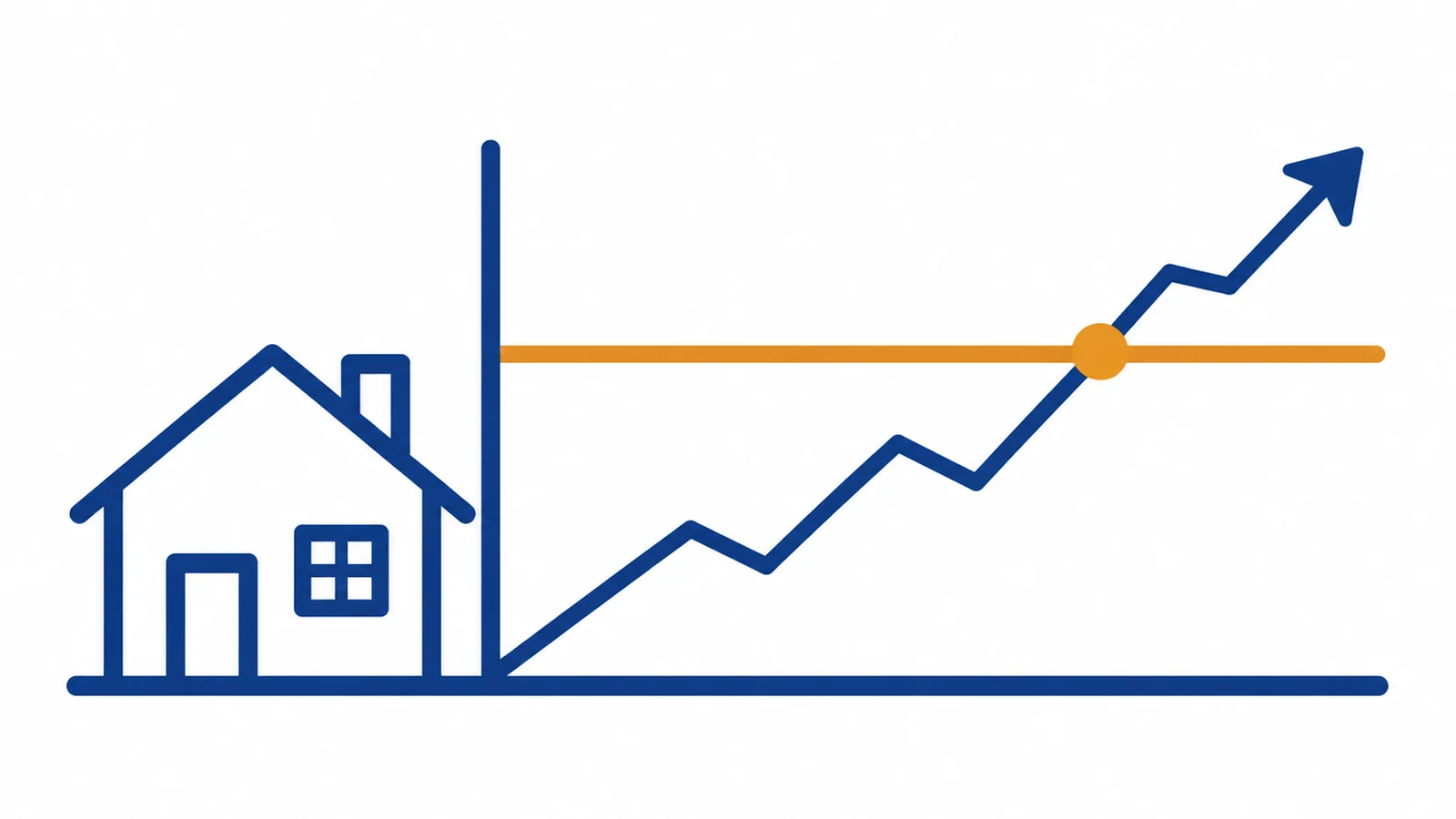
A trigger rate is the interest rate at which a variable-rate mortgage with fixed payments only covers interest, leaving nothing for principal. FCAC says beyond it the lender generally adds unpaid interest to your balance (negative amortization) and normally charges interest on it. On an assumed $500,000 mortgage set at 4.00%, the trigger rate is about 6.33%. Contact your lender early; options include converting to fixed, adjustable payments, a blend option or a prepayment.
Key takeaways
- →The trigger rate is the rate at which your mortgage payment only covers interest, so none goes toward principal.
- →It applies to a variable-rate mortgage with fixed payments; with adjustable payments the payment changes with the rate.
- →FCAC says beyond the trigger rate the unpaid interest is generally added to your balance and normally charged interest too.
- →In our assumed $500,000 example set at 4.00%, the trigger rate is about 6.33%, and a 7.00% rate for five years leaves the balance about $84,300 higher.
- →FCAC's advice is to contact your lender as soon as possible. A licensed agent can compare options across 65+ lenders, OAC.
Short answer: A trigger rate is the interest rate at which your mortgage payment only covers interest, so none of it goes toward paying down the principal; the Financial Consumer Agency of Canada (FCAC) says that if you pass it, your lender will generally add the unpaid interest to your balance and your mortgage goes into negative amortization [1]. It applies to a variable-rate mortgage with fixed payments, where the payment stays the same while the rate moves. On an assumed $500,000 mortgage with a payment set at 4.00%, the trigger rate works out to about 6.33%, by our calculation.
If you have this type of mortgage and your rate has risen, read the steps below and contact your lender early. For the fixed-versus-variable choice itself, see fixed vs variable mortgages. Everything here is general information, OAC.
What is a trigger rate?
With a variable-rate mortgage, FCAC says you may keep your payments the same for the whole term, which lenders call a fixed payment with a variable interest rate [2]. When rates rise, more of each payment automatically goes toward interest [2]. The trigger rate is the point where that share reaches 100%: the payment covers interest and nothing else [1].
FCAC also describes a second type: an adjustable payment with a variable rate, where the payment changes when the rate changes [2]. With adjustable payments you feel a rate rise in your budget sooner, but there is no trigger rate in the same sense, because the payment keeps up with interest. Ask your lender which type your contract is.
Worked example: how the payment splits as rates rise
Assume a $500,000 variable-rate mortgage with a 25-year amortization, where the fixed payment was set when the rate was 4.00%. That payment is about $2,639 a month. The table shows the first month's split at higher rates on the same $500,000 balance. This is a simplification (variable rates normally compound monthly and the balance changes over time), and every figure is our calculation, not a quote.
| Rate | Interest in the month | Left for principal | If you wanted the payment to keep up |
|---|---|---|---|
| 4.00% | $1,667 | $973 | $2,639 (as set) |
| 5.00% | $2,083 | $556 | $2,923 |
| 6.00% | $2,500 | $139 | $3,222 |
| 6.33% (trigger) | $2,639 | $0 | n/a |
| 7.00% | $2,917 | Short by $277 | $3,534 |
| 8.00% | $3,333 | Short by $694 | $3,859 |
Once the rate passes the trigger, the shortfall is added to the balance. FCAC says lenders normally charge interest on that unpaid interest too, so the balance keeps growing [1]. If the rate stayed at 7.00% for five years with the payment unchanged, our model puts the balance at about $519,900, compared with about $435,500 had the rate stayed at 4.00%. That is a gap of roughly $84,300.
Not sure which type of variable mortgage you have? A licensed 8Twelve agent can review your contract and your options across 65+ lenders, OAC. Try the renewal calculator or contact us.
Why it matters at renewal
FCAC warns that you could end up owing more than you expected, and that you may have to contribute more capital to avoid problems renewing your mortgage [2]. A balance that has grown during the term means a larger loan against the same home when it is time to renew, which can matter for the lender's rules on loan size and value. See the mortgage renewal guide.
What you can do
FCAC's advice is to contact your lender as soon as possible, because acting early prevents the situation from getting worse [1][2]. Options FCAC lists for people in difficulty include:
- Convert from variable to fixed. FCAC says you may be able to convert, which can protect you from further increases [1]. Ask what fixed rate is offered and any fee.
- Switch to adjustable payments. The payment rises with the rate, so principal keeps being paid [2]. It is a higher payment, but the balance does not grow.
- Blend-to-term or blend-and-extend. The lender combines your current rate with today's rate. FCAC says this may lower payments when the current rate is lower than your mortgage rate, so it will not help if rates are still climbing [1]. See blend and extend.
- Prepay. A lump sum lowers the balance and the interest. See prepayment privileges.
Longer amortization lowers payments but adds interest; FCAC says extending can add thousands or tens of thousands of dollars [3]. Compare the total cost, not only the payment. If you are already behind, see refinancing when you're behind on payments.
From our agents: borrowers often learn about the trigger rate from a lender letter rather than from their contract. Check your mortgage contract and your most recent statement for the words "fixed payment" or "adjustable payment" before you decide anything, OAC.
Step by step: checking your own mortgage
- Find out your type: fixed payment with a variable rate, or adjustable payment.
- Ask your lender for your trigger rate and your current balance in writing.
- Compare the trigger rate with your current rate. If they are close, act now.
- Price the options above including any fees and penalties.
- Re-check each statement to see whether your balance is falling or rising.
Frequently asked questions
What is a trigger rate on a mortgage?
The interest rate at which your payment only covers interest, so none goes toward principal, according to FCAC. It applies to variable-rate mortgages with fixed payments.
What happens if I pass my trigger rate?
FCAC says lenders generally add the unpaid interest to your mortgage, which is called negative amortization, and normally charge interest on it as well.
Do adjustable-rate mortgages have a trigger rate?
With adjustable payments, the payment changes when the rate changes, so it keeps covering interest. Check your contract for the specifics.
Can I convert a variable mortgage to a fixed rate?
FCAC says you may be able to convert, which can protect you from further rate increases. Ask your lender about the rate offered and any fees.
How do I find my trigger rate?
Ask your lender in writing. It depends on your payment, balance, amortization and rate, so it changes as you pay the mortgage down.
Use our payment calculator to see what an adjustable payment would be at a higher rate.
This article is for general information only and isn't financial, legal or tax advice. Rates, products and terms change without notice and are available on approved credit (OAC). The rate and terms you qualify for depend on your individual financial situation, including credit, income, property and loan-to-value. "Best rates" means the most suitable options available for your situation, not a guarantee of the lowest rate. Examples are for illustration only, as of November 23, 2026, and are not an offer. 8Twelve Mortgage arranges mortgages through 65+ lenders and does not lend directly. Licensed across Canada — see our licences.
This article is for general information only. The trigger rate definition, negative amortization, interest on unpaid interest, the fixed-payment and adjustable-payment types, the renewal warning and the relief options come from FCAC's mortgage relief options and choosing a mortgage pages, and the amortization warning from FCAC's renewing your mortgage page, all checked November 21 to 22, 2026. The $500,000 mortgage, 25-year amortization, 4.00% starting rate and higher rates are assumptions for illustration, not offers; the payment, interest split, trigger rate (about 6.33%) and balances are our calculations using monthly compounding, which simplifies how lenders calculate. The "From our agents" tip is our general experience. Lending is available on approved credit (OAC).
Frequently asked questions
Sources
Last reviewed on November 24, 2026