
Mortgage relief options in Canada if you cannot pay
If you cannot make a mortgage payment, the FCAC lists relief options. See deferral, blended terms, amortization changes and what to avoid. OAC.
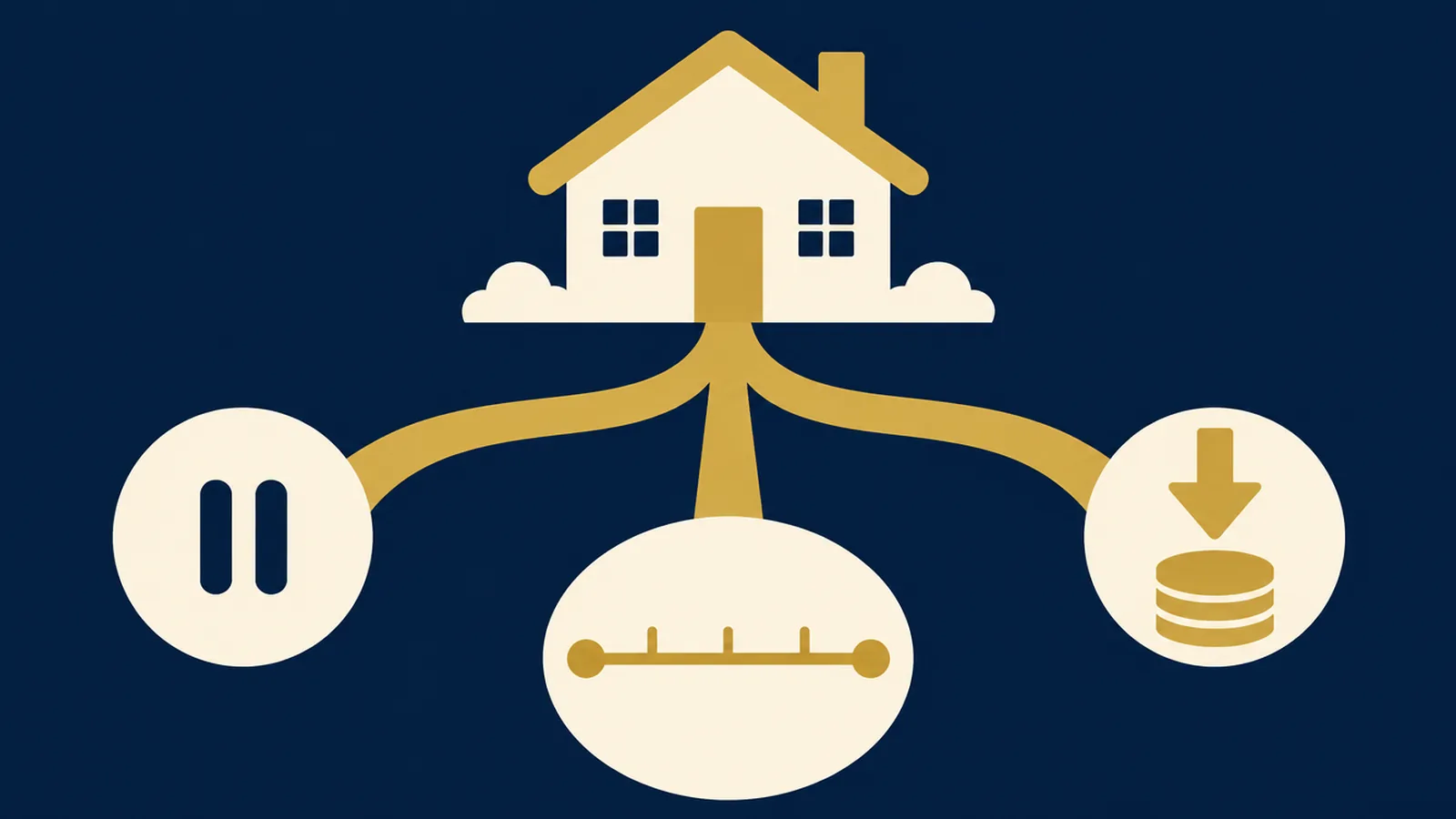
If exceptional circumstances make it hard to keep up with your mortgage, the FCAC says to contact your financial institution as soon as you can. Federally regulated institutions are expected to help. Options can include renegotiating, using features already in your agreement, a payment deferral, a longer amortization, capitalization, interest-only payments, or selling the home. Some options cost more over the life of the loan.
Key takeaways
- →The FCAC says to contact your financial institution early if exceptional circumstances make payments hard to meet. Federally regulated institutions are expected to help.
- →Options can include converting variable to fixed, a blend-to-term or blend-and-extend, re-borrowing prepayments, or a skip-a-payment feature already in your agreement.
- →The FCAC warns against using a HELOC to make the mortgage payment, because the limit can be cut or the full amount called.
- →A standard deferral is usually up to 4 months. Extending amortization lowers the payment but raises interest; the FCAC's illustration is a $300,000 mortgage at 5%.
- →Other measures include capitalization, interest-only payments (often up to about $10,000, repaid within 2 years), or a sale-by-borrower plan, typically 90 days or less. A licensed agent can review options across 65+ lenders, OAC.
Short answer: If exceptional circumstances make it hard to keep up with your mortgage, the Financial Consumer Agency of Canada (FCAC) says to contact your financial institution as soon as you can and ask about options that fit your situation [1]. Federally regulated institutions are expected to help. The options can include renegotiating the rate or term, using features already in your agreement, a payment deferral, a longer amortization, special payment arrangements, capitalization, interest-only payments, or selling the home [1].
This guide walks through the menu the FCAC publishes. It does not replace a conversation with your lender, and some options cost more over the life of the loan. Lending is available on approved credit (OAC). For a short pause specifically, see our guide to mortgage payment deferral.
Contact the institution early
The FCAC's examples of exceptional circumstances include the combined effects of high household debt, a higher cost of living, and rapid increases in interest rates [1]. That can show up at renewal, on a variable-rate payment that has already risen, or when a variable-rate mortgage with fixed payments reaches its trigger rate [1].
Waiting until a payment has already been missed usually narrows the options. The FCAC's starting point is to call before that happens and ask what is available on your agreement.
Renegotiating the rate or term
You may be able to renegotiate. The FCAC notes that converting a variable rate to a fixed rate can add stability if rates are rising, and that a lower current rate can sometimes be used to reduce payments [1].
Some institutions offer a blended rate, which combines your existing rate with the current rate. Blend-to-term keeps the new rate until the end of your current term. Blend-and-extend, sometimes called an early renewal, starts a new, longer term so the blended rate lasts longer [1]. For how those options work in more detail, see our guide to a blend-and-extend mortgage.
Features already in your agreement
The FCAC says to check the features already in your mortgage before you ask for a new arrangement [1].
If you have made lump-sum prepayments in the current term, some institutions will let you re-borrow that amount. It is typically added back to the principal, which increases interest costs [1].
A skip-a-payment option, also called a payment pause, miss-a-payment or take-a-break, may let you skip a limited number of payments in a calendar year. Some lenders will only allow it if you have already prepaid, and they apply those prepayments to the skipped payment. In other cases the payment is deferred [1].
The FCAC is direct about using a home equity line of credit to make the mortgage payment: it may put you at risk. The institution can lower the limit or call the full amount at any time [1].
If you already have optional credit insurance, you may be able to make a claim after a job loss, a critical illness or a disability. The FCAC says claims typically wait 1 to 2 months, the maximum monthly benefit is usually around $3,000, and payments last only for a limited time [1]. Read the certificate. Our guide to mortgage disability insurance covers what to check before you rely on that cover.
Payment deferral, a longer amortization and other relief
A standard payment deferral is an agreement to delay payments, usually for up to 4 months. When the deferral ends you repay what was skipped, the amortization may be longer, you will owe more than before, and the payment amount may rise [1]. An extended deferral lasts longer than that usual 4-month window and is often capped at a set amount, for example $10,000 [1]. The math and the catch-up choices are in our deferral guide.
Extending the amortization lowers the payment but raises total interest. The FCAC's illustration is a $300,000 mortgage at 5%: 20 years at $1,971.38 a month with $173,130 of interest, versus 30 years at $1,601.07 a month with $276,386 of interest [1]. Those figures are an illustration only. For insured mortgages (down payment under 20%), the maximum amortization is 30 years for a first-time buyer or a new build, and 25 years in other cases; for uninsured mortgages the lender sets the maximum [1]. See our guide to extending amortization and our explainer of mortgage amortization in Canada.
Other measures the FCAC lists include special payment arrangements that reduce payments for an agreed period and recover late amounts over the shortest period you can manage; capitalization, which adds missed payments, and sometimes property taxes, utilities, repairs or condo fees, to the principal; and interest-only payments, which defer principal usually up to a maximum around $10,000, often to be repaid within 2 years [1].
The FCAC notes that relief measures may increase the total cost of the mortgage over its remaining life [1]. Federally regulated institutions are expected to offer measures that fit your circumstances. Other lenders may have a different menu, or none of these options, so you have to ask.
Selling the home
If you are at risk of default, selling can lower payments, reduce expenses, or let you use the equity in the property. Some institutions offer a sale-by-borrower plan: you list the home at fair market value, typically for 90 days or less, and you continue to occupy and maintain it, sometimes with full or partial payments still due [1].
If a sale or a missed-payment path is already further along, see our guide to power of sale in Ontario. The rules differ by province.
Worried about a payment you cannot make? A licensed 8Twelve agent can review options across 65+ lenders, OAC. Talk to us.
From our agents
The most useful call is the one you make before a payment is missed. Bring a short list of what has changed (income, a renewal date, a trigger-rate notice) and ask which of the FCAC options your lender will actually consider. Not every option will be on the table, and some cost more later. That is our general experience, not a guarantee of relief.
This article is for general information only and isn't financial, legal or tax advice. Rates, products and terms change without notice and are available on approved credit (OAC). The rate and terms you qualify for depend on your individual financial situation, including credit, income, property and loan-to-value. "Best rates" means the most suitable options available for your situation, not a guarantee of the lowest rate. Examples are for illustration only, as of November 26, 2026, and are not an offer. 8Twelve Mortgage arranges mortgages through 65+ lenders and does not lend directly. Licensed across Canada — see our licences.
This article is for general information only and isn't financial or legal advice. The exceptional-circumstances examples, the list of relief options, the typical credit-insurance claim figures, the usual deferral window, the $10,000 examples, the $300,000-at-5% amortization illustration, insured amortization limits and the sale-by-borrower timeline come from the FCAC's Mortgage relief options page, checked November 26, 2026. Other lenders may not offer the same options. The "From our agents" tip is our general experience. Lending is available on approved credit (OAC).
Frequently asked questions
Sources
- Mortgage relief options - Financial Consumer Agency of Canada
Last reviewed on November 27, 2026