
Reverse mortgage vs HELOC: which costs less if you're retired and need $100,000?
A HELOC usually has a lower rate but needs monthly payments and income to qualify. A reverse mortgage needs no payments, but interest compounds onto the balance. Here's a side-by-side comparison and a $100,000 example over 5, 10 and 15 years.
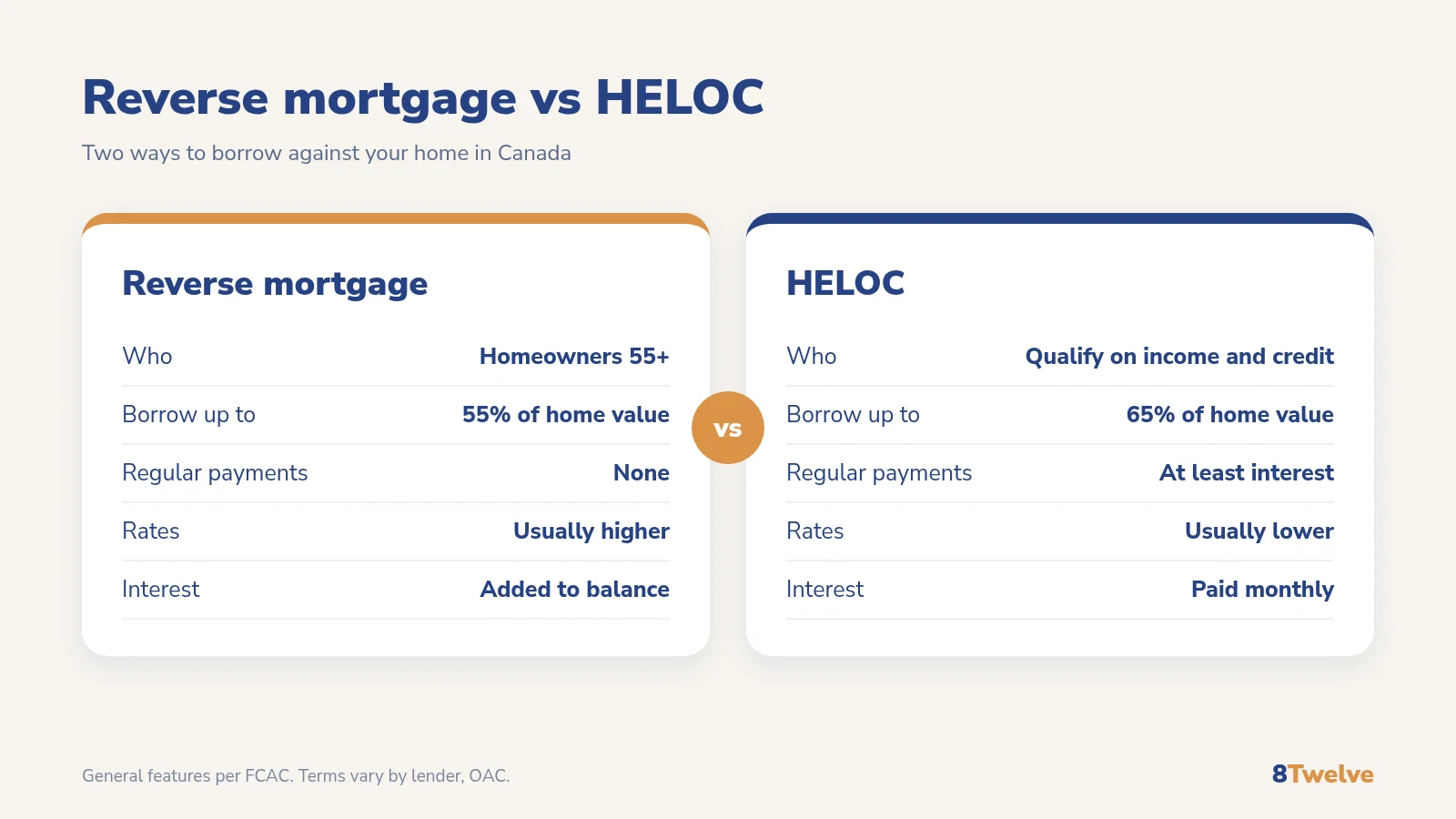
In the reverse mortgage vs HELOC choice, a HELOC usually has a lower rate and lets you borrow up to 65% of your home's value, but you must qualify on income and credit and make at least interest payments. A reverse mortgage is for homeowners 55+, lets you borrow up to 55% with no regular payments, but rates are usually higher and interest is added to the balance. FCAC says you usually can't hold both on the same home. In our example, $100,000 on a HELOC at an illustrative 5.70% costs about $475 a month interest-only ($57,000 over 10 years, and the $100,000 is still owed). On a reverse mortgage at an illustrative 7.00%, no payments are due but the balance grows to about $198,979 after 10 years. OAC.
Key takeaways
- →Reverse mortgage vs HELOC comes down to payments vs growth: a HELOC needs monthly payments; a reverse mortgage doesn't, but its balance grows.
- →A HELOC lets you borrow up to 65% of your home's value; a reverse mortgage, up to 55%, for owners 55 and older, according to FCAC.
- →HELOCs need income to qualify, including the stress test at federally regulated lenders; with a reverse mortgage, the amount depends mostly on age and the home.
- →Rates on reverse mortgages are usually higher than on HELOCs, and interest compounds on the balance.
- →You can't have both at once on the same home; a reverse mortgage must pay off any existing HELOC or mortgage.
Short answer: For most retirees comparing a reverse mortgage vs HELOC, the HELOC usually costs less if you can qualify and comfortably make the monthly payments. A reverse mortgage usually costs more over time, but it requires no regular payments [1][2], and in our experience it's easier to qualify for on a retirement income. The right choice depends on your cash flow, how long you'll stay in the home and how much equity you want to leave.
This guide is for homeowners 55 and older who want to tap their home equity without selling. We compare the two side by side and run a $100,000 example over 5, 10 and 15 years. For the full rules on the reverse side, see our reverse mortgage options.
What is a reverse mortgage? What is a HELOC?
A reverse mortgage is a loan secured by your home that lets you access up to 55% of its current value if you're 55 or older; you don't make regular payments, and the loan is repaid when you sell, move out or the last borrower dies [1].
A home equity line of credit (HELOC) is a revolving line secured by your home. You can borrow, repay and borrow again up to your limit, and you must make at least interest payments every month [3].
Reverse mortgage vs HELOC: side by side
| Feature | Reverse mortgage | HELOC |
|---|---|---|
| Who it's for | Homeowners 55+ (all on title) [1] | Any homeowner who qualifies [3] |
| Maximum | Up to 55% of the home's value, minus your mortgage balance [2] | Up to 65% of the home's value; combined with a mortgage, up to 80% [2][3] |
| Qualifying | Amount depends on age, home value, location, type and condition [1]; in our experience, income plays a small role | Income, credit and debt ratios; federally regulated lenders apply the stress test [3] |
| Monthly payments | None required; interest is added to the balance [1] | At least interest each month [3] |
| Rate | Usually higher than a mortgage or HELOC [1] | Usually variable, tied to prime [3] |
| Fees | Appraisal, legal, set-up and closing costs [1] | Possible appraisal, legal and title fees [3] |
| When it's repaid | When you sell, move out, the last borrower dies or you default [1] | Anytime; the lender sets the terms [3] |
| Effect on equity | Shrinks over time as interest compounds [1] | Stays steady if you pay interest; grows if you pay principal |
Rules from FCAC; each lender sets its own criteria.
One rule matters for planning: FCAC says that with a reverse mortgage you usually can't also have a HELOC on the same home, and any existing mortgage or HELOC must be paid off from the reverse mortgage funds [1].
Retired and weighing your options? A licensed 8Twelve agent can compare a reverse mortgage and a HELOC for your situation across 65+ lenders, OAC. Prefer the phone? Many 55+ clients do. Explore reverse mortgage options
What it costs: a $100,000 example
Example: you're 70, your home is worth $800,000, it's mortgage-free and you need $100,000 for home repairs and a cushion.
| After | HELOC at 5.70%, interest-only | Reverse mortgage at 7.00%, no payments |
|---|---|---|
| Monthly payment | about $475 | $0 |
| 5 years | $28,500 paid in interest; still owe $100,000 | owe about $141,060 |
| 10 years | $57,000 paid in interest; still owe $100,000 | owe about $198,979 |
| 15 years | $85,500 paid in interest; still owe $100,000 | owe about $280,679 |
Rates are illustrative assumptions as of November 4, 2026, and are not offers: the HELOC uses prime of 4.70% plus 1%, and the reverse mortgage rate is an assumption, compounded semi-annually. HELOC rates are usually variable and can change. Fees, home value changes and lump-sum vs staged draws aren't included. Your actual rate depends on your situation, OAC.
What it shows: after 10 years, the HELOC has cost $57,000 in payments plus the $100,000 still owed, about $157,000 in total. The reverse mortgage costs nothing month to month, but about $198,979 is owed. The gap is the price of not making payments plus the higher rate. If $475 a month would strain your budget, though, the reverse mortgage may be the more realistic option. Our guide to reverse mortgage requirements in Canada covers who qualifies.
Pros and cons
HELOC pros - Usually a lower rate than a reverse mortgage [1]. - Borrow only what you need, repay and reuse it [3]. - Your equity doesn't shrink if you keep up with interest.
HELOC cons - You need income and credit to qualify, which can be harder on a retirement income [3]. - Monthly payments are required, and a variable rate can rise [3]. - Interest-only payments don't reduce what you owe.
Reverse mortgage pros - No regular payments [1]. - The amount depends mainly on your age and your home [1]; in our experience, income plays a much smaller role than with a HELOC. - In our experience, it's often used to replace an existing mortgage payment and free up monthly cash flow.
Reverse mortgage cons - Rates are usually higher, and interest compounds on the balance [1]. - Less equity left for you or your estate over time [1]. - Prepayment penalties can apply if you sell or repay early [1].
Which fits your situation?
- A HELOC may fit if your pension and investment income easily cover the payments, you'll need money in stages and you want to keep as much equity as possible. Our guide to HELOC rates in Canada explains how pricing works.
- A reverse mortgage may fit if monthly payments would strain your budget, you plan to stay in the home for many years and leaving the most equity isn't your top goal.
- Neither may fit if you're likely to move within a few years. FCAC suggests also considering downsizing or renting [1]; see our comparison of reverse mortgage vs downsizing.
From our desk: a common pattern is a couple who qualifies for a HELOC today but worries about payments once one pension stops. In those cases we model both options for the surviving spouse's income, not just today's household income, before anyone decides.
Step by step: comparing both with a broker
- List what you need the money for and when, as a lump sum or over time.
- Gather income documents: pension statements, CPP and OAS, and investment income.
- Get an estimate of your home's value and list any mortgage or HELOC on title.
- Compare both options with a licensed agent, including rates, fees and how much equity remains after 5, 10 and 15 years.
- Involve family and get independent legal advice, which FCAC suggests for reverse mortgages [1].
When to look at other options
If you only need a small amount, a personal line of credit or using savings may cost less in fees. If you still have a mortgage with a few years left, a refinance or renewal may change the math. And because reverse mortgage money is a loan, not income, it generally doesn't affect OAS or GIS; our reverse mortgage tax guide explains the details.
In the reverse mortgage vs HELOC decision, a HELOC usually costs less if you can qualify and keep up with payments, while a reverse mortgage trades a higher long-term cost for no monthly payments. Run both on your own numbers, over the years you expect to stay, before you choose.
Next step: see how payments compare with our mortgage payment calculator, or read about reverse mortgages in Ontario.
This article is for general information only and isn't financial, legal or tax advice. Rates, products and terms change without notice and are available on approved credit (OAC). The rate and terms you qualify for depend on your individual financial situation, including credit, income, property and loan-to-value. "Best rates" means the most suitable options available for your situation, not a guarantee of the lowest rate. Example rates and payments are for illustration only, as of October 2026, and are not an offer. 8Twelve Mortgage arranges mortgages through 65+ lenders and does not lend directly. Licensed across Canada — see our licences.
Reverse mortgage interest accrues and reduces your home equity over time. We recommend involving family and obtaining independent legal advice. Example rates are for illustration only, as of November 4, 2026, and are not an offer; your actual rate depends on your situation, OAC. Prime of 4.70% reflects the rate posted by major lenders after the Bank of Canada's October 28, 2026 decision. Rules checked against FCAC on November 4, 2026. 8Twelve does not lend or fund mortgages; we arrange them with third-party lenders.
Frequently asked questions
Sources
Last reviewed on November 5, 2026