
Reverse mortgage pros and cons in Canada
Reverse mortgage pros and cons in Canada: no regular payments and tax-free cash, versus higher rates and a growing balance. See an assumed example.
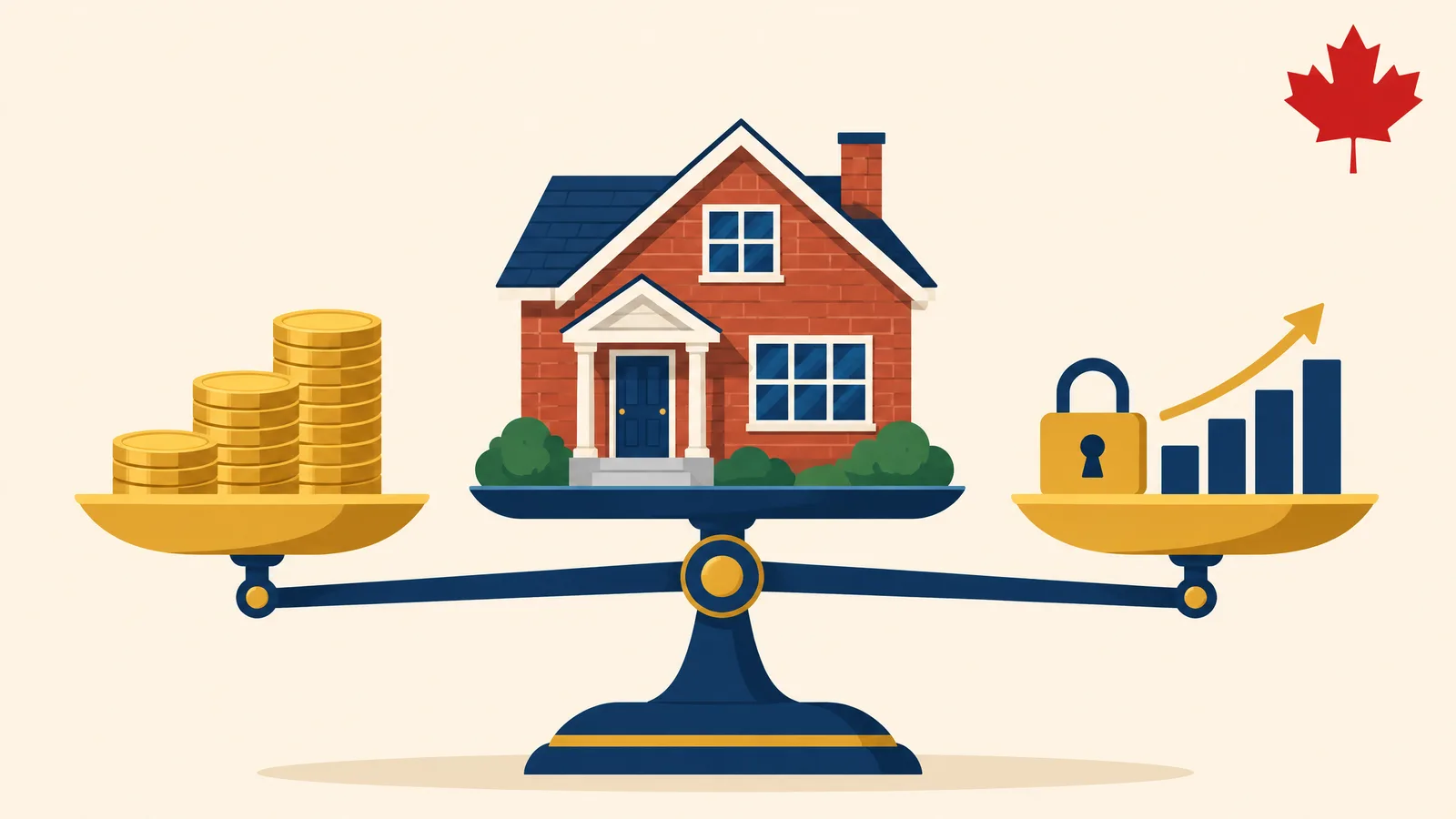
A reverse mortgage lets homeowners usually 55 or older borrow up to about 55% of their home's value without regular payments, tax-free, with OAS and GIS unaffected. The cons are a higher rate than a mortgage or HELOC, interest added to the balance, fees, and less equity for your estate. Compare other options first.
Key takeaways
- →FCAC says you may usually borrow up to 55% of your home's value, with no regular payments and tax-free money that doesn't affect OAS or GIS.
- →The rate is usually higher than a mortgage or HELOC, and interest is added to the balance, so your equity may go down over time.
- →In our assumed example, $100,000 at 7% grows to about $196,715 after 10 years, about 28% of a $700,000 home.
- →The loan must be repaid when you sell, move out, the last borrower dies or you default, and your estate may have limited time to repay.
- →Compare a HELOC, downsizing and other options first. A licensed agent can compare 65+ lenders, OAC.
Short answer: A reverse mortgage lets homeowners usually aged 55 or older turn some home equity into tax-free cash without selling and without regular payments, but the interest is added to the balance, so the amount you owe grows over time. The Financial Consumer Agency of Canada (FCAC) says you may usually borrow up to 55% of your home's current value, and the rate is usually higher than a mortgage or a HELOC [1]. It tends to suit people who plan to stay in the home and have compared the alternatives, not people who need a short-term loan.
This guide sets the pros and cons side by side with an assumed example, and points to our detailed guides on each cost and rule, OAC.
What a reverse mortgage is, in one paragraph
A reverse mortgage is a loan for homeowners, usually aged 55 or older, that lets you borrow against your home equity without selling the home [1]. FCAC says the home must usually be your primary residence, which typically means you live in it at least six months a year, and the maximum depends on your age, the home's condition, type and appraised value, and your lender [1]. See our guide to reverse mortgage requirements for the detail.
The pros
- No regular payments required. FCAC says you don't need to make regular payments on a reverse mortgage [1].
- You still own your home. You turn some of its value into cash without selling it [1].
- The money is tax-free. FCAC says you don't pay tax on the money you borrow [1].
- OAS and GIS are not affected. FCAC says the money doesn't affect Old Age Security or Guaranteed Income Supplement benefits you may be getting [1]. Our reverse mortgage tax guide goes deeper.
- Flexible payout options. You may be able to take a lump sum, part now and the rest over time, or regular payments [1].
- Use of funds. FCAC says you may use the money for anything you wish, such as repairs, regular bills, healthcare or repaying debts, but ask your lender about restrictions and fees [1].
The cons
- Higher interest rates. FCAC says the rate is usually higher than a mortgage or a HELOC [1].
- The balance grows. Your lender adds the interest to the loan, so your equity may go down as interest accumulates [1].
- Costs beyond the rate. They may include an appraisal, a set-up fee, legal fees, closing costs and a prepayment penalty if you repay early [1]. See reverse mortgage fees and reverse mortgage cost.
- Less for your estate. There may be less money left for your children or other beneficiaries, and your estate may need to repay the loan and interest within a set period [1]. Read what happens after death.
- Fewer other borrowing options. FCAC says a reverse mortgage may limit other financing secured on your home, and you may need to pay off existing mortgages or HELOCs [1].
- Repayment triggers. The balance must be repaid when you sell, move out, the last borrower dies or you default [1].
How fast can the balance grow? An assumed example
Here is a simple illustration. Suppose you borrow $100,000 as a lump sum at an assumed 7% interest rate, compounded annually, with no payments and no further advances, on a home we assume stays worth $700,000. The rate and home value are assumptions for illustration, not a quote, and real rates, compounding and fees vary by lender.
| After | Approximate balance owed | Share of a $700,000 home |
|---|---|---|
| 5 years | $140,255 | about 20% |
| 10 years | $196,715 | about 28% |
| 15 years | $275,903 | about 39% |
The balance roughly doubles in ten years at that assumed rate. If your home also rises in value, the share of equity used would be smaller. If it doesn't, it would be larger. Fees added to the balance would make every number higher.
Who it can suit, and who should look elsewhere
FCAC suggests comparing other options first, including selling and buying a smaller home, renting or moving to assisted living, or getting another loan such as a HELOC, a mortgage or a personal loan [1]. A few questions can help:
- Do you plan to stay in the home for many years?
- Would you qualify for a cheaper product, such as a HELOC? FCAC says a HELOC may be limited to 65% of your home's value and usually has a variable rate [2]. See reverse mortgage vs HELOC.
- Would downsizing give you the cash with fewer long-term costs? See reverse mortgage vs downsizing.
- Have you talked to your family and a financial advisor about the impact on your estate? FCAC suggests doing so, and in some provinces your lender may require independent legal advice [1].
A licensed agent can compare structures across 65+ lenders, including how much you could borrow at your age. See reverse mortgage options at 8Twelve, OAC.
Frequently asked questions
What are the main pros and cons of a reverse mortgage?
The main pros are no regular payments, tax-free money, you keep ownership and OAS and GIS are not affected. The main cons are a higher interest rate, a growing balance, fees, and less equity left for your estate.
How much can I borrow with a reverse mortgage in Canada?
FCAC says you may usually borrow up to 55% of your home's current value. The amount depends on your age, the home and your lender.
Do I have to make payments on a reverse mortgage?
No regular payments are required, and you may be able to make payments up to a maximum amount or repay in full at any time. Interest still builds on the balance, and you may pay a fee if you repay early.
Does a reverse mortgage affect OAS or GIS?
FCAC says the money you borrow doesn't affect Old Age Security or Guaranteed Income Supplement benefits.
When does a reverse mortgage have to be repaid?
FCAC says you repay when you sell, move out, the last borrower dies or you default. Lenders set their own timelines for you or your estate to repay.
Use our mortgage payment calculator to compare other ways to borrow.
This article is for general information only and isn't financial, legal or tax advice. Rates, products and terms change without notice and are available on approved credit (OAC). The rate and terms you qualify for depend on your individual financial situation, including credit, income, property and loan-to-value. "Best rates" means the most suitable options available for your situation, not a guarantee of the lowest rate. Examples are for illustration only, as of November 20, 2026, and are not an offer. 8Twelve Mortgage arranges mortgages through 65+ lenders and does not lend directly. Licensed across Canada — see our licences.
This article is for general information only. The 55% guideline, costs, pros, cons and repayment triggers come from FCAC's reverse mortgage page, and the HELOC limit from FCAC's HELOC page, both checked on November 20, 2026. The $100,000 loan, 7% rate, annual compounding and $700,000 home value are assumed examples, not a quote or a forecast, and exclude fees and further advances. Reverse mortgage terms vary by lender and province. Lending is available on approved credit (OAC).
Frequently asked questions
Sources
- Reverse mortgages - FCAC
- Home equity lines of credit - FCAC
Last reviewed on November 21, 2026